Our biggest news is the Ebola outbreak in Africa. We have been watching as it spreads across Western Africa, staying aware of how close it approaches the Republic of Congo.
On Sunday, August 24, we received reports of death from Ebola in the Equatorial Province of the Democratic Republic of Congo (across the river from us.) This is a separate strain and separate outbreak of the Ebola virus than in Western Africa, and the virus was traced to someone preparing bushmeat.
We confirmed our evacuation plan with our team, and we have kept an eye on the situation. The short version of our evacuation plan is that if the outbreak comes closer or grows significantly bigger, we would evacuate all non-medical personnel and short term people. Then if things progress, the decision would be made to evacuate the medical personnel as well. With the difficulty of travel to and from Impfondo, it was necessary to make sure we have the possibility of chartered flights for evacuation.
Part of our team evacuation plan is that everyone is free to make the decision to leave earlier if they believe that would be best for themselves and their family. For some of our team, their mission has chosen to have them travel to Brazzaville- as soon as they can get commercial airline tickets. However, they won’t just be waiting in Brazzaville. They will help coordinate the efforts to set up an Ebola screening and response plan for Impfondo.
The border between the two Congos has been closed in this area. The affected area has been placed under quarantine. So far, there have been no significant changes with the outbreak in the DRC, and our family will be staying here in Impfondo.
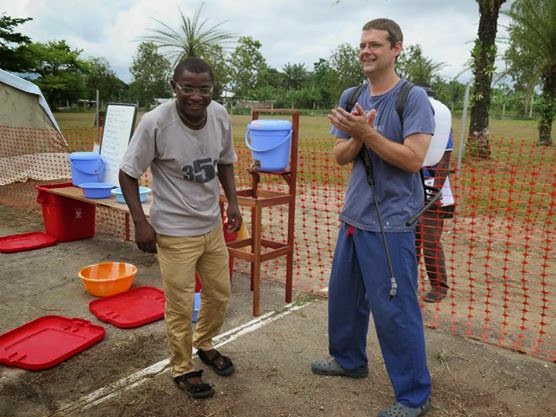
Our hope is that the Ebola outbreak in the DRC will not spread here. However, we are preparing for the potential spread. Stephen has been meeting with government officials and other NGO’s in the area to talk about Ebola prevention and education. The local officials are taking this very seriously. There are plans to have public health campaigns, including announcements on the radio. Dr. Cyriaque (medical school graduate from the CAR) was able to attend one of these meetings on Saturday when Stephen was busy with patients. He came back with posters and information to place around the hospital. It’s encouraging to us to see an African doctor taking an active roll here at the hospital.
Stephen has been training our hospital guards how to do a screening at the gate, and have those with suspicious symptoms wait for a nurse to evaluate them rather than entering the general hospital area. The nurses will have special training classes as well.
At this point, our hospital is not equipped or staffed to treat Ebola. We do not want to put our nurses and other workers at risk if we do not have proper equipment. The local government hospital will have isolation areas, and patients will be referred there. Things could change if outside help arrives. Pray for wisdom with all these decisions.
In the meantime, we are trying to keep life as normal as possible. The kids start school tomorrow, and they are enjoying the last of their summer. They are aware of the possibility of evacuation, and know that we would be temporarily separated from Stephen. Having been through possible evacuations before, they take it all in stride.
Ebola is big news right now, but it is still much more likely for people in Africa to die from other causes- malaria, malnutrition, various infections, wars, other violence, tetanus, childbirth… the list goes on. Please continue to pray for the victims of Ebola, but also the other people in Africa. With many of the healthcare personnel withdrawing, it is even more difficult than usual to get access to healthcare. There are attempts made to calculate the numbers who have died from Ebola, but there is no way to calculate the indirectly related deaths.
What’s next:
1) Pray for our teammates who are traveling to Brazzaville, hopefully this Wednesday, September 3. There are many logistical details involved.
2) Stephen will be the only fully trained doctor here. That is difficult at the best of times, and this is not the best of times. We are grateful that Dr. Cyriaque can help, but he has not completed his training and still needs supervision. Pray for Stephen’s health and energy levels as he does medical work, as well as the extra work involved to prepare for a potential outbreak and a potential evacuation.
3) Our homeschool-ICI Academy- starts tomorrow. (September 2)
4) Nurses training and education will continue with the focus switching to preventing, recognizing, and treating Ebola.
5) We bought our tickets to go to Soddo Christian Hospital in Ethiopia for the month of November. It’s hard to think that far ahead right now, but if all goes well, Stephen will spend November learning a type of orthopedic surgery.
6) Repatriation of people from the DRC has begun. So far, it has not affected our employees. Pray for those involved, and for those living with uncertainty. The situation has been further complicated by the closing of the border between the countries in the area.
7) Ebola continues to spread, especially in Western Africa. Pray for all those effected by Ebola, directly and indirectly.
8) It may still be necessary for us to evacuate. Pray for our family’s safety and health, and for wisdom in making decisions about staying or going.
 |
| This graphic shows the life cycle of the ebolavirus. Bats are strongly implicated as both reservoirs and hosts for the ebolavirus. Of the five identified ebolavirus subtypes, four are capable of human-to-human transmission. Initial infections in humans result from contact with an infected bat or other wild animal. Strict isolation of infected patients is essential to reduce onward ebolavirus transmission. from www.cdc.gov |